Fraud Intel · Global signal report · Latest published data
Every year, more of the world's spending moves onto cards, phones and checkout pages. And every year, criminals follow the money. The latest figures show card fraud now costs more than $33 billion a year worldwide. Identity thieves are opening and hijacking credit card accounts faster than ever, and online card fraud cases keep climbing. This is a field report on where card fraud stands, how criminals get your card details, and what it will take to stop them.
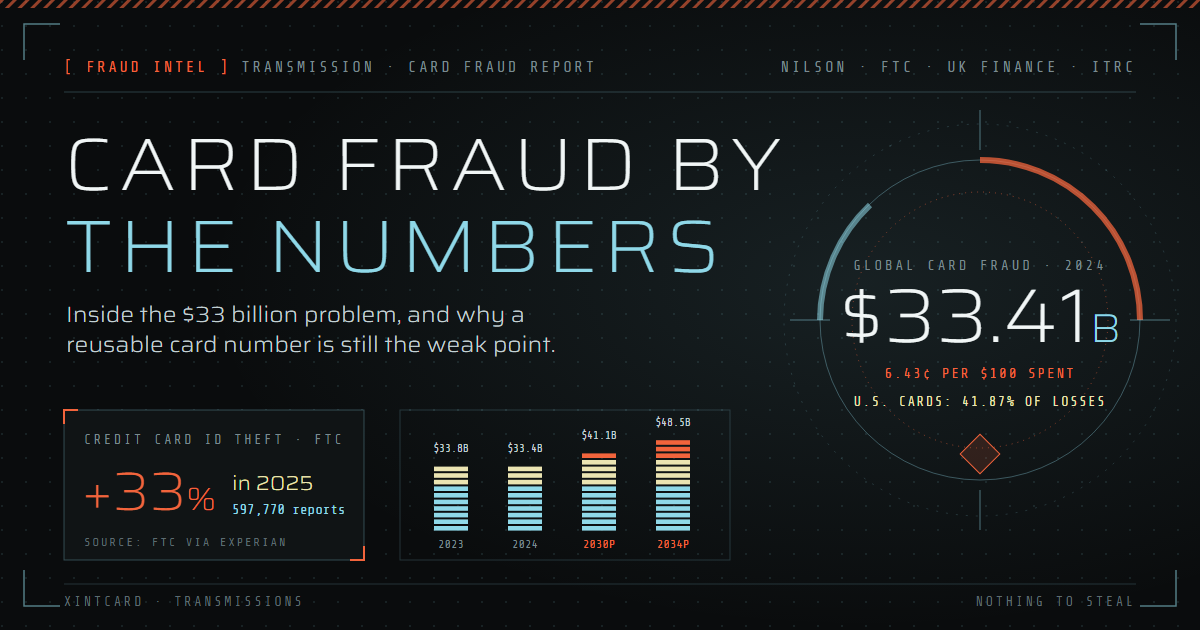
Worldwide card fraud losses in 2024, with $41 billion a year projected by 2030 (Nilson Report).
Share of global card fraud losses tied to U.S. cards, which make up only 26.31% of card volume.
Credit card identity theft reports to the FTC in 2025, up 33% in a single year.
UK online and phone card fraud cases in 2025, up 13% (UK Finance).
The global picture: a $33 billion problem
The Nilson Report, which has tracked the card industry for decades, puts worldwide card fraud losses at $33.41 billion in 2024. That is the money lost by card issuers, merchants and payment processors to fraudulent card payments and ATM transactions. It was a small dip, down 1.2% from 2023, but the long-range outlook points one way:
| Year | Card fraud losses | Card volume | Trend |
|---|---|---|---|
| 2023 | $33.83 billion | $51.43 trillion | |
| 2024 | $33.41 billion | $51.92 trillion | |
| 2030PROJECTED | $41.06 billion | $70.73 trillion | |
| 2034PROJECTED | $48.50 billion | $84.76 trillion |
Nilson projects cumulative card fraud losses of $407.60 billion over the next ten years. The fraud rate is edging down, from 6.58¢ to 6.43¢ for every $100 spent between 2023 and 2024, but card spending is growing so fast that the total keeps rising. A slightly smaller slice of a much bigger pie is still more money stolen.
America's outsized share
U.S. cards account for about a quarter of the world's card spending but more than two-fifths of its card fraud losses:
| Measure (2024) | U.S. share | |
|---|---|---|
| Global card volume | 26.31% | |
| Global card fraud losses | 41.87% |
Fraud flows to the easiest targets. The United States adopted chip cards later than much of the world, still has magnetic-stripe readers in daily use, and has a vast online retail market where a stolen card number, expiry date and security code are all a thief needs.
Identity thieves are coming for credit cards
The Federal Trade Commission's 2025 figures, which collect reports from consumers and partner agencies, show identity theft accelerating, and credit cards are its number-one target:
| FTC measure | 2024 | 2025 | Change |
|---|---|---|---|
| Credit card identity theft reports | 449,094 | 597,770 | +33% |
| All identity theft reports | 1,135,265 | 1,358,253 | +20% |
| Fraud reports | 2.6 million | 3.0 million | +15% |
| Reported fraud losses | $12.5 billion | $15.9 billion | +27% |
Credit card identity theft covers both new accounts that criminals open in a victim's name and existing accounts they take over. In both cases the victim is left to untangle debts they never ran up. Credit cards were also the payment method people named most often in 2025 fraud reports, ahead of bank transfers and cryptocurrency.
The online front: card-not-present fraud
Once card details are stolen, most are used where no physical card is needed: online checkouts, phone orders and digital wallets. The United Kingdom publishes some of the most detailed card fraud data in the world, and its 2025 figures show the pattern clearly:
| UK fraud type (2025) | Losses | Cases |
|---|---|---|
| Remote purchase (online, phone, mail order) | £423.5 million+3% | 3.2 million+13% |
| Lost and stolen cards | £109.8 million−2% | 449,189+2% |
| All unauthorized fraud | £703.4 million−5% | 3.81 million+11% |
Cases are rising faster than losses, which tells its own story. Criminals are making more, smaller fraudulent payments that are less likely to trigger alarms. UK Finance also warns that fraudsters are using increasingly sophisticated social engineering to trick victims into handing over one-time passcodes, which they then use to add stolen cards to their own digital wallets or to approve fraudulent payments. Banks are fighting back: the UK industry prevented £1.68 billion of unauthorized fraud in 2025, but the attacks keep coming.
Where stolen card data comes from
Card fraud runs on a supply chain. Before a single fraudulent payment is made, card details have to be stolen, packaged and sold. The main sources:
| Source | How it works | Latest signal |
|---|---|---|
| Data breachesBULK THEFT | Criminals break into retailers, service providers and financial firms that store card and identity data. | A record 3,322 U.S. data compromises in 2025, with about 278.8 million victim notices. Financial services was the most breached sector for the second year running (ITRC). |
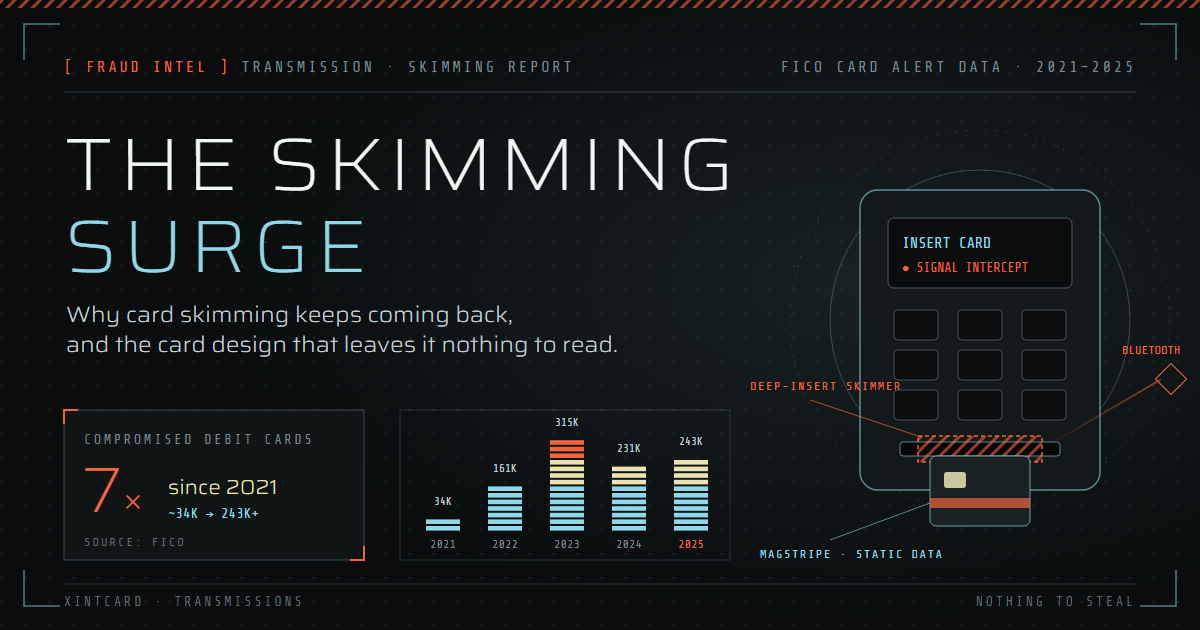
| SkimmingPHYSICAL CAPTURE | Hidden devices in ATMs, gas pumps and terminals copy card data and PINs. | 243,000+ U.S. debit cards compromised in 2025, with compromise events up 90% (FICO). Read our skimming report. |
| Phishing and smishingSOCIAL ENGINEERING | Fake texts, emails and websites trick people into typing in card details or one-time codes. | Text messages were the contact method in more than 411,000 FTC fraud reports in 2025. |
| Card testingBOTS | Automated bots try stolen or generated card numbers with tiny charges to find the ones that work. | Working numbers are resold or used for larger purchases, often within hours. |
| Lost and stolen cardsPHYSICAL THEFT | A card in the wrong hands is spent quickly, often by tapping. | 449,189 lost and stolen card cases in the UK in 2025. |
Why card fraud keeps growing
Every one of these attacks steals the same thing: a card number that keeps working for whoever holds it.XINTCARD FRAUD INTEL
1. The card number is a permanent secret
A standard card number, expiry date and security code stay the same for years. They are printed on the card, stored by merchants and typed into countless websites. Every place they appear is a place they can leak from, and once they leak they keep working until the card is cancelled.
2. More spending, more attack surface
Global card volume is projected to grow from about $52 trillion to more than $84 trillion within a decade. Every new online store, subscription and connected device is another place card data is entered or stored.
3. Criminals target people, not just systems
As chips and fraud models make technical attacks harder, criminals turn to people: convincing texts, spoofed calls and fake bank staff asking for "verification codes". A one-time passcode handed to a scammer can unlock a card just as surely as a stolen number.
4. Fraud is industrialized
Stolen card data is bought and sold in bulk, tested by bots, and cashed out by organized networks. Running a fraud operation now takes little more than buying the tools.
What breaks the cycle
Detection, alerts and chargebacks limit the damage, but they act after the theft. The real fix is to make stolen card data useless:
| Defense | What it stops |
|---|---|
| Tokenization | Merchants receive a stand-in token instead of the real card number, so a breached database exposes nothing reusable. |
| One-time cryptograms | Each payment carries a unique code that cannot be replayed, defeating skimming and cloning. |
| Dynamic security codes | A security code that changes makes stolen online card details expire quickly. |
| Real-time verification | Checking every payment as it happens stops fraud before money moves, not weeks later. |
| Strong customer authentication | Confirming payments in a banking app, rather than with codes that can be read out to a scammer, makes social engineering harder. |
XintCard is designed to combine these defenses in a single card: no static card number, no magnetic stripe, credentials sealed inside a secure chip, one-time tokens for every payment and a dynamic security code, with every payment verified in real time. When there is no reusable number, breaches, skimmers and phishing pages have nothing worth stealing. Compare XintCard with a regular card.
Field guide: protect your cards today
- Turn on instant alerts for every transaction on every card, and act on anything you don't recognize.
- Never share a one-time code. Your bank will never call, text or email to ask for one. Anyone who does is a scammer.
- Pay with a phone wallet or tap where you can. Both use tokens instead of your real card number.
- Use a credit card for online shopping rather than debit, so fraud doesn't drain your checking account while you dispute it.
- Freeze your credit with the three U.S. credit bureaus. It is free and stops criminals from opening new cards in your name.
- Don't save cards on sites you rarely use, and use strong, unique passwords with two-step sign-in on shopping and banking accounts.
- Check statements monthly, including small charges. Card-testing bots often start with a charge of a dollar or two.
If your card has been compromised
- Call your card issuer immediately, using the number on the back of your card, to lock the card and dispute unauthorized charges. Reporting quickly protects your rights to recover the money.
- Ask for a new card number and update any subscriptions or saved payment details yourself.
- Check your credit reports for accounts you didn't open. You can get free reports at AnnualCreditReport.com.
- If someone opened an account in your name, report it at IdentityTheft.gov for a personal recovery plan.
The bottom line
Card fraud is not slowing down. It is scaling with the economy, at more than $33 billion a year and heading past $40 billion. The rate of fraud per dollar spent edges down, but the total climbs, because the card itself still carries a secret that works for anyone who steals it. Stronger detection buys time. Removing the reusable secret ends the game. That is what XintCard is built to do. Join the early-access list to be among the first to carry a card with nothing to steal.
Sources
- The Nilson Report, card fraud losses worldwide 2024 (Issue 1298), as reported in "Global Card Fraud Losses at $33 Billion", January 2026. See also nilsonreport.com.
- Federal Trade Commission 2025 data, as reported by Experian (updated July 2026) and "FTC reveals a record $15.9 billion in consumer fraud losses in 2025", March 2026.
- UK Finance, Annual Fraud Report 2026, June 2026.
- Identity Theft Resource Center 2025 Data Breach Report, as reported by National Mortgage News, January 2026.
- FICO Card Alert Service 2025 data, as reported by TechTimes, July 2026.